Back in 2021 I wrote a post called “Ready for Brexit with S/4HANA.” It was a config and readiness checklist for a hard deadline that, when you got under the hood, was mostly about master data and tax codes being right before the date arrived. Here is the 2026 version of that same kind of post. Same shape, different country, and this deadline is a law that does not move.
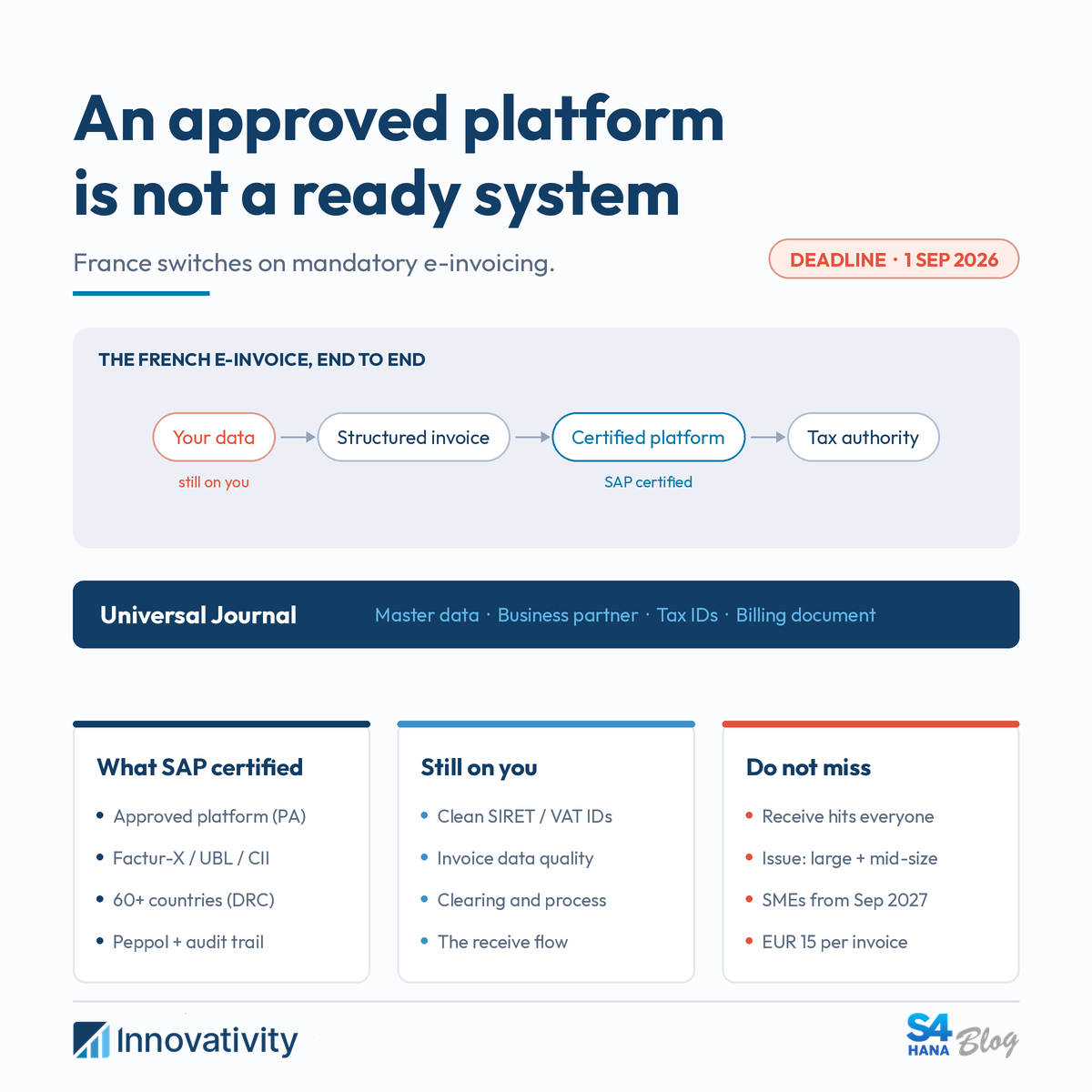
On 1 September 2026 France switches on its national B2B e-invoicing mandate. That is just under ten weeks away. From that date, large and mid-sized companies must issue structured electronic invoices, and every VAT-registered business in France, including the ones that do not have to issue yet, must be able to receive them. Smaller companies get until September 2027 to start issuing. The invoices flow through government-certified platforms, in one of three structured formats, and there is a fine per invoice if you get it wrong.
And right on cue, the headline that everyone shared: on 4 February SAP was validated as an approved platform by the French tax authority. Good news, genuinely. But if you read that and think the project is done, you have mistaken the easy part for the whole job. Let me explain why, because this is exactly the kind of gap I spend my working life pointing at.
What 1 September actually asks of you
First, the part people get right, because it is the part that is written down clearly.
From 1 September 2026 the invoice can no longer be a PDF you email or a piece of paper you post. It has to be a structured electronic invoice in Factur-X, UBL 2.1 or CII, the three formats that meet the European norm EN 16931. It cannot go direct to your customer either. It goes through a certified platform, a Plateforme Agreee or a partner dematerialisation platform, which validates it, routes it and reports the data to the tax authority. The old free public portal, the PPF, has stepped back from issuing invoices itself and now mostly concentrates and routes the data.
So there are really two obligations hiding in one date, and they are not the same size. Issuing is the one everyone is planning for. Receiving is the one that quietly applies to everybody on day one. More on that in a minute, because that is where I see people about to trip.
SAP as an approved platform, read honestly
Here is what SAP being validated actually means. It means SAP’s compliance platform, Document and Reporting Compliance, passed the interoperability testing and is on the list of providers France will accept. SAP says that platform now covers more than sixty countries, handles e-invoicing, e-reporting and e-audit, talks to the Peppol network, and keeps the full transaction trail an auditor will ask for. If you are already an SAP Finance shop, that is one less vendor decision and one less integration to argue about. I am not going to pretend that is nothing. It is real and it is useful.
But notice what it is. It is the pipe. SAP got the pipe certified. The pipe was never the part I was worried about.
The part I worry about is everything that has to be true before a clean structured invoice can even be built and pushed into that pipe. And that part is not on SAP’s certification. It is on you.
The receive obligation is the trap
Let me say this one plainly, because it is the cheapest mistake to avoid and the most common one I expect to see.
Even if your French entity is too small to be forced to issue e-invoices in 2026, you still have to be able to receive them from 1 September 2026. Every VAT-registered business does. So the company that reads “issuing starts for big companies first” and files this under “not my problem until 2027” has just misread its own obligation. Your suppliers who are large will start sending you structured invoices this September, and your system has to take them in, read them, and post them. If it cannot, your incoming invoice process stops on a date you did not put in your plan.
I would put the receive flow at the top of the test list, not the bottom. It is the one with no grace period and the one nobody is rehearsing.
It still comes down to your master data
And now the part that will not surprise anyone who has read this blog for a while. A structured invoice is only as good as the data underneath it.
Picture a mid-sized manufacturer with one French sales company. Four thousand or so active French business partners on the customer side. Now go and check how many of them have a French company identifier, a SIRET, that is blank, mistyped, or out of date. In every migration I have ever touched the answer is “more than you hoped.” Today that does not hurt you, because a human catches it later, or the invoice goes out as a PDF and nobody validates the buyer’s tax ID at all. A structured Factur-X invoice does not give you that grace. The field is mandatory and validated. The invoice either builds clean or it does not build.
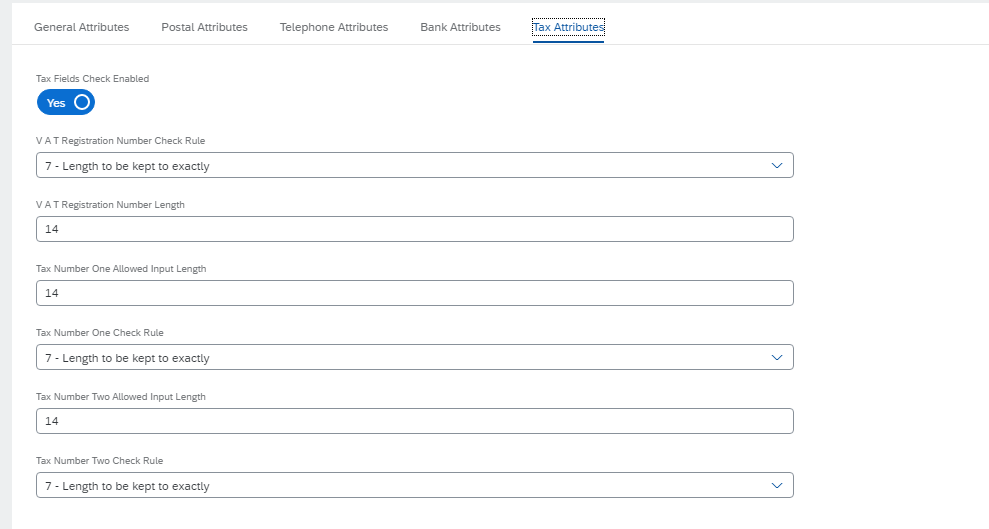
So the work between now and September is not really an e-invoicing project. It is a master-data project wearing an e-invoicing hat. Clean the tax identifiers. Check the addresses. Look at the invoices that today need a manual touch before they post, because every one of those is a structured invoice that will fail on 1 September. That is the foundation point I keep coming back to, post after post. The pressure is on the foundation, not on the platform sitting on top of it.
What I actually find interesting here
Let me turn the other way for a second, because it is not all warnings. The bigger picture genuinely interests me. What France, Italy, Poland and the EU’s ViDA programme are all doing is turning the invoice into real-time tax infrastructure. The tax authority stops waiting for a quarterly return and starts seeing the transaction as it happens. Italy has run this model since 2019. Poland switched on KSeF this February. ViDA pushes it to intra-EU B2B trade by 2030. This is a structural change in how tax works, and the ERP is suddenly sitting right in the middle of it.
And the thing I like, the part I want to get my hands on, is that SAP is putting the compliance inside the Finance system instead of bolting a third tool onto the side. A native path from the billing document to the certified format to the authority, with the audit trail attached, is the right design. I have not run the full France 2026 setup end to end in a live landscape yet, so take the exact certified-format and configuration list from SAP’s own note, not from me. But I want to sit down with it in a sandbox and push a real French invoice all the way through, and I will write that up properly when I have.
So where does that leave you
My honest verdict: SAP getting validated as an approved platform is good, and it is the 20 percent of this that was always going to be fine. The 80 percent that decides whether your September goes smoothly is your master data, your incoming-invoice process, and the receive obligation you might not have on your plan yet. None of that is on a certification SAP can hand you. It is design and readiness work, and it is exactly the kind of unglamorous thing that does not get budgeted until an invoice fails to build.
Ten weeks is enough time to fix data. It is not enough time to discover in late August that the data was the problem.
If your French entity is in scope, what is your plan for the receive flow, and have you actually looked at how many of your tax identifiers are clean? Let me know in the comments. Stay tuned.
