Last week I argued that none of the week’s SAP stories were really about the agents, and that the pressure was on the foundation underneath them. So let me be fair and turn around this week. One of them *is* about an agent. And it is not a side-show agent that drafts an email or summarises a report. It is the one that posts to your ledger.
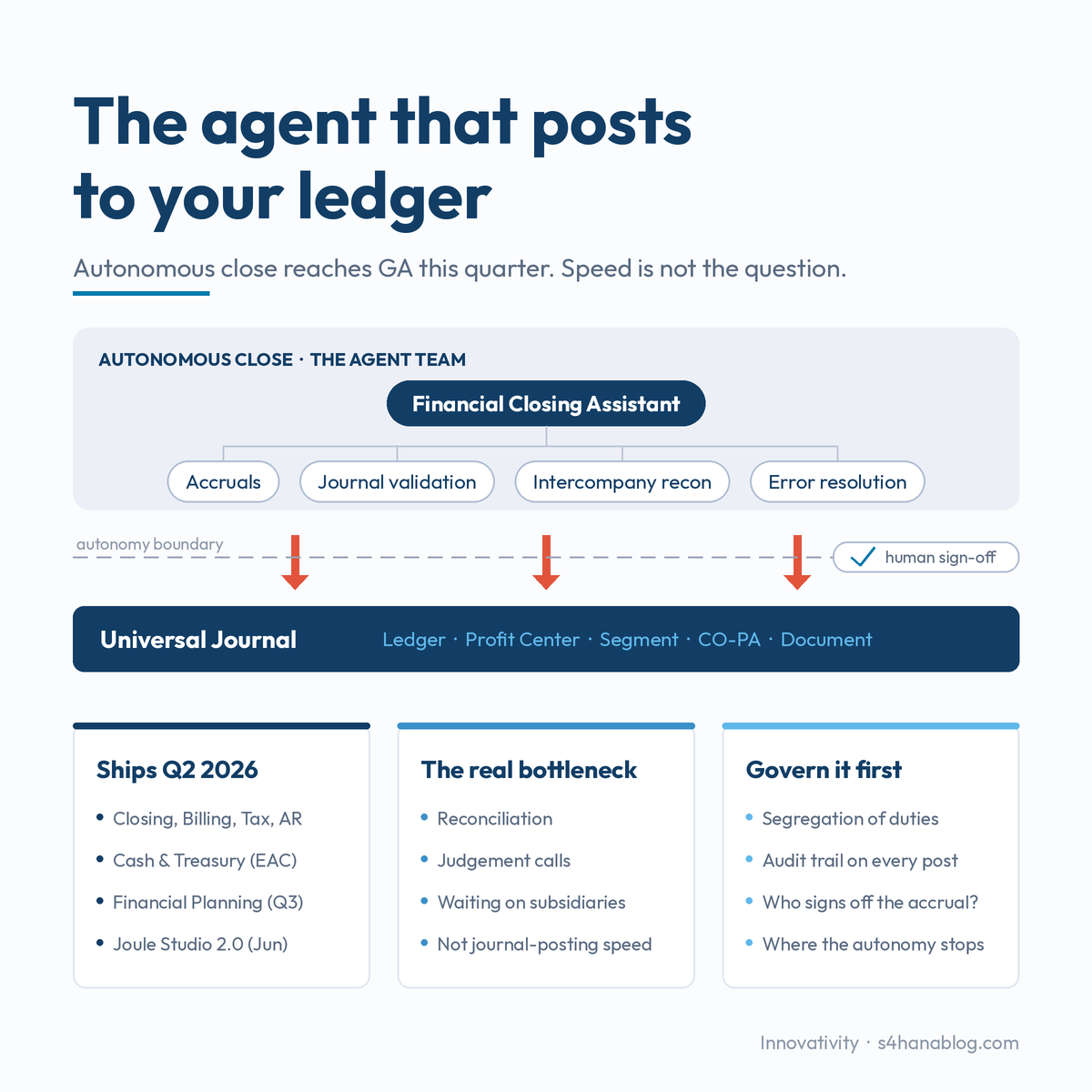
SAP put it on stage at Sapphire in Madrid as part of the Autonomous Suite, and the Financial Closing Assistant reaches general availability in Q2 2026. That is this quarter. It orchestrates a team of Joule agents that post entries, calculate accruals, validate journals, reconcile intercompany and resolve errors during the period close. You can set how much autonomy each agent gets. And the headline number SAP keeps repeating is that it takes the close “from weeks to days.”
I have not run it in a real close yet. GA is this quarter, so take the exact scope from SAP’s own note, not from me. But I have closed enough books to know which questions matter, and “weeks to days” is not the first one.
What actually ships this quarter
The close assistant does not arrive alone. The same Q2 wave brings the Billing Assistant, the Tax and Compliance Assistant and the Accounts Receivable Assistant to GA. Cash and Treasury comes through Early Adopter Care, and Financial Planning is lined up for Q3. Underneath sits Joule Studio 2.0, the thing you build custom agents in, with first customers in June and its own GA pushed to Q3. SAP talks about 200-plus agents across 50-odd assistants. One detail that will interest this audience: the finance agents run on foundation models from outside SAP, Anthropic’s Claude among them. So a third-party model now sits inside your close. Park that thought, we will come back to it.
The part I actually like is the autonomy dial. You decide, per agent, whether it only analyses, or also clears, or goes all the way to posting. That is the right design. It admits the obvious truth that you are not going to let an agent post a top-side adjustment on day one, but you might happily let it match and clear intercompany lines that used to eat a junior accountant’s afternoon. Good. That is how this should work.
“Weeks to days,” read honestly
Here is where I get less excited. The close is not slow because posting journals is slow. The close is slow because of *reconciliation, judgement and waiting*. Waiting for the subsidiary in another time zone. Deciding whether a provision is reasonable. Chasing the one intercompany mismatch that will not tie out. Explaining a variance to a controller who does not believe the number.
An agent absolutely helps with the mechanical layer. Take a recurring service accrual: two company codes, a €240K cross-charge, the kind of entry that is identical every month until the month it is not. An agent posting and reconciling that, with the audit trail attached, is genuinely useful and frees a person for the judgement calls. I will take that.
But the days you actually lose at close are the judgement days, and an agent that posts faster does not give them back. It compresses the part that was already the cheap part. Worth doing. Just do not confuse it with the bottleneck.
The question SAP did not fully answer
SAP gave CFOs a timeline. It did not give them the full governance picture, and the trade press said as much. That gap is the whole story for a Finance person.
Think about what an autonomous posting agent does to your control framework. Segregation of duties was built around *people*: the person who posts is not the person who approves. So when an agent both calculates the accrual and posts it, who is the second pair of eyes? When it clears an intercompany difference inside a tolerance, who set that tolerance, and is the decision in the audit trail or buried in a config table nobody reviews? When it posts the wrong accrual at 2am on a model from a vendor outside SAP, whose name is on the journal? “The agent did it” is not an answer your external auditor will accept.
None of this makes the assistant a bad idea. It makes governance the design work, not an afterthought you bolt on once the demo lands. The autonomy boundary, who can move it, and what gets logged when an agent acts, that is the part worth your design time. Not the speed.
It still sits on the foundation
And now back to the thought I asked you to park. Every one of these agents posts into the Universal Journal. They read your master data, your account determination, your margin model. Which means the same thing I said last week is even more true here: an autonomous close is only ever as good as the ledger underneath it.
If your CO-PA is attributing margin to the wrong segment, the agent will reconcile cleanly to the wrong number, on time, with a tidy audit trail. That is worse than a slow manual close that at least had a human frowning at the variance. The financial truth still has to match the operational reality. An agent does not create that match. It assumes it.
So my honest take, before I have hands on it: the autonomy dial is the right idea, the mechanical automation is real and useful, and the speed claim is the least interesting thing about it. The work this quarter is not switching the assistant on. It is deciding what it is allowed to do, proving the foundation it posts onto is clean, and writing the governance down before the auditor asks. I will test it properly once GA lands and report back with screenshots and a real close behind it.
What are you seeing? Is anyone treating agent autonomy and segregation of duties as a design decision yet, or is it still “let’s switch it on and see”? Let me know in the comments. Stay tuned.
Sources
- SAP News Center: SAP Unveils the Autonomous Enterprise (Sapphire 2026): https://news.sap.com/2026/05/sap-sapphire-sap-unveils-autonomous-enterprise/
- SAP Community: Introducing the Financial Closing Assistant (scope, autonomy levels): https://community.sap.com/t5/financial-management-blog-posts-by-sap/introducing-the-financial-closing-assistant/ba-p/14395125
- SAP: AI Assistant for Financial Closing (use case): https://www.sap.com/use-cases/joule-assistant/financial-closing-ai
- SAPinsider: SAP’s Autonomous Finance Push Gives CFOs a Timeline, but Not the Full Governance Picture: https://sapinsider.org/blogs/sap-autonomous-finance-grc-cfo-governance/
- ERP.Today: SAP’s Autonomous Finance Push Turns CFO Attention to Governance: https://erp.today/sap-autonomous-finance-cfo-governance
- Constellation Research: SAP Sapphire 2026, the autonomous enterprise platform: https://www.constellationr.com/insights/news/sap-sapphire-2026-sap-makes-its-case-it-should-your-autonomous-enterprise-platform
- SaaS News: SAP Launches Joule Studio 2.0 with 200 AI Agents (Claude powers finance agents; availability): https://www.saasrise.com/news/sap-unveils-joule-studio-20-with-200-enterprise-ai-agents-for-finance-supply-chain-and-hr-ec727990-4692-4d17-bc43-913d5db0b72e
